
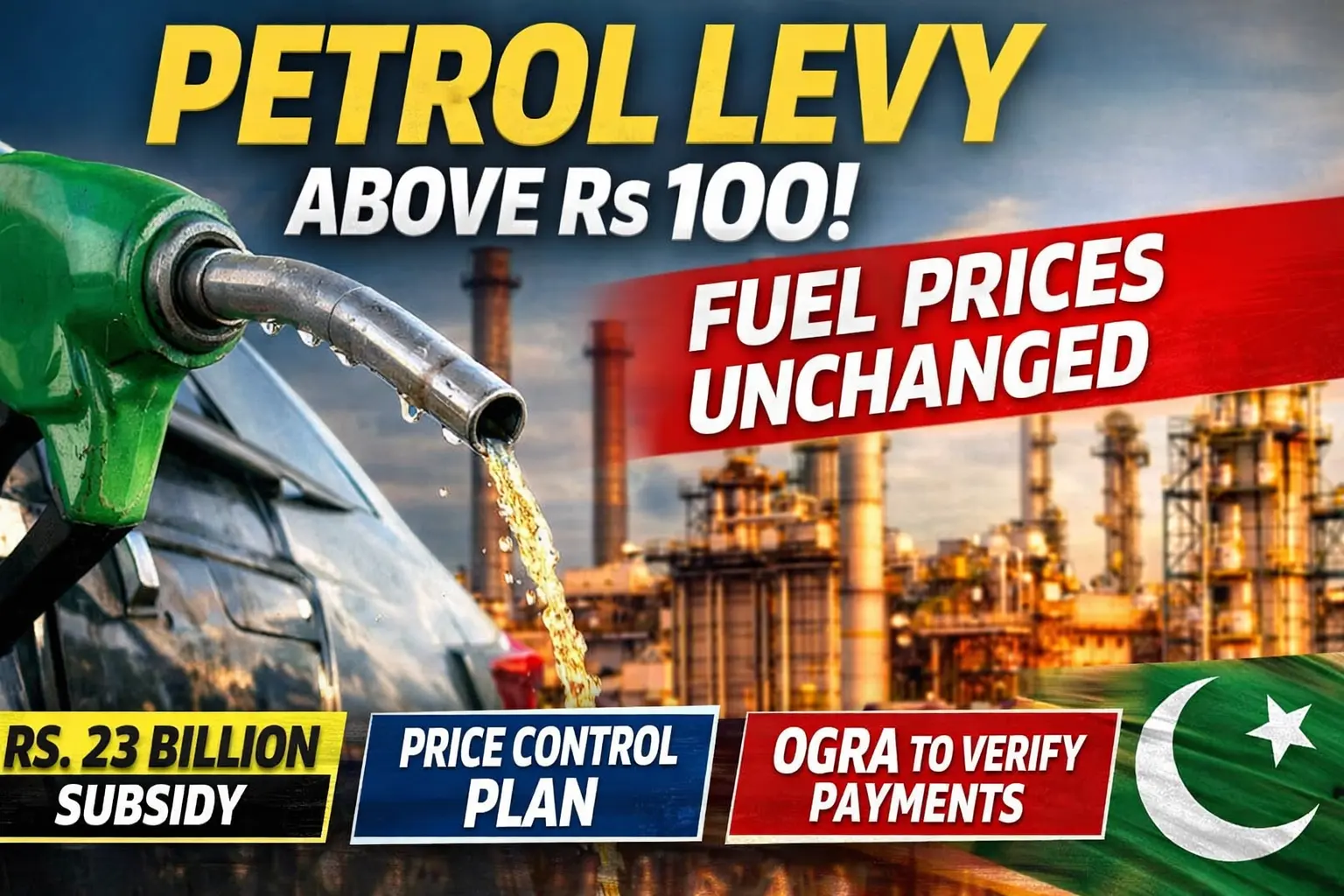
Petrol Levy on Petrol Stays Above Rs. 100 in Pakistan Complete Details and Impact on Consumers
Fuel prices in Pakistan remain one of the most important issues for the public and the economy. Recently, the government announced that the petrol levy on petrol will remain above Rs. 100 per litre. At the same time, the government has decided to keep petrol and diesel prices unchanged for the current review period.
This decision aims to provide temporary relief to the public while managing the country’s financial pressures. In this article, we will explain everything in simple and easy English, including the latest petrol levy rates, government subsidy details, the role of OGRA, and what this decision means for consumers in Pakistan.
Current Petrol and Diesel Prices in Pakistan
According to the latest official notification, the government has decided not to increase fuel prices for the current period. This means consumers will continue paying the same rates for petrol and diesel.
The current fuel prices are:
- Petrol Price: Rs. 321.17 per litre
- Diesel Price: Rs. 335.86 per litre
These prices will remain unchanged until the next petroleum price review.
The decision has been taken to avoid further financial pressure on the public, especially at a time when inflation and living costs are already high in Pakistan.
Petrol Levy on Petrol Remains Above Rs. 100
Even though the government kept fuel prices stable, it has not reduced the petrol levy.
The current petrol levy rates are:
- Petrol Levy: Rs. 105.37 per litre
- Diesel Levy: Rs. 55.24 per litre
The petrol levy is a tax collected by the government on petroleum products. It is an important source of revenue for the government and helps finance different public expenditures.
Keeping the levy unchanged means the government is continuing to rely on petroleum taxation while controlling the retail price through subsidies.
Why the Government Kept Fuel Prices Unchanged
Fuel prices in Pakistan are affected by many factors such as:
- International oil prices
- Exchange rate fluctuations
- Government taxes and levies
- Transportation and distribution costs
In the latest review, the government decided to keep fuel prices unchanged to reduce public pressure. Rising petrol prices usually lead to higher transportation costs, which eventually increase prices of food and other essential items.
By maintaining the same fuel prices, the government hopes to control inflation and provide short-term relief to the public.
Government Announces Rs. 23 Billion Subsidy
To keep petrol and diesel prices stable, the government has announced a subsidy worth Rs. 23 billion.
This subsidy will help cover the difference between the actual cost of fuel and the retail prices being charged to consumers.
Without this subsidy, petrol and diesel prices could have increased significantly.
Per Litre Subsidy on Petrol and Diesel
Under the current pricing arrangement, the government will provide the following subsidy amounts:
Petrol Subsidy
- Rs. 49.63 per litre subsidy on petrol
Diesel Subsidy
- Rs. 75.05 per litre subsidy on diesel
This support helps prevent immediate increases in fuel prices and protects consumers from sudden cost hikes.
However, subsidies also place a financial burden on the national budget.
How Oil Companies Will Receive Subsidy Payments
The subsidy will not be paid directly to consumers. Instead, it will be provided to oil marketing companies (OMCs) through a mechanism called Price Differential Claims (PDCs).
What Are Price Differential Claims?
Price differential claims are payments made by the government to compensate oil companies for selling fuel at a lower price than the actual market cost.
This system ensures that:
- Oil companies do not suffer financial losses
- Fuel supply remains stable in the market
- Consumers continue to pay controlled prices
Role of OGRA in the Subsidy System
The Oil and Gas Regulatory Authority (OGRA) plays an important role in the implementation of fuel subsidies.
OGRA is responsible for:
- Reviewing subsidy claims submitted by oil companies
- Verifying the accuracy of bills
- Auditing the claims before payments are released
This process helps ensure transparency and accountability in the distribution of government subsidies.
Only verified claims will receive payments from the government.
Prime Minister’s Austerity Fund and Fuel Price Support
To manage the financial burden of subsidies, the government has also created the Prime Minister’s Austerity Fund.
The Economic Coordination Committee (ECC) approved the transfer of Rs. 27.1 billion into this fund.
Allocation of Funds
Out of the total amount:
- Rs. 23 billion will be transferred to OGRA
- This money will be used specifically for petrol and diesel subsidy payments.
This financial arrangement helps the government maintain current fuel prices without immediately increasing taxes or retail rates.
Official Communication Sent to OGRA
The Ministry has already started the implementation process.
The Director General (Oil) has formally sent instructions to OGRA regarding the price differential payment mechanism.
This official communication confirms that:
- The subsidy system is active
- Oil companies can submit their claims
- OGRA will review and process the payments
This step ensures that the fuel price support plan works smoothly.
What This Decision Means for Consumers
For ordinary citizens, this decision brings temporary financial relief.
Key Benefits for the Public
- Petrol and diesel prices will not increase immediately
- Transportation costs will remain stable
- Inflation pressure may reduce slightly
Stable fuel prices can also help businesses manage operational costs more effectively.
However, the unchanged petrol levy means that consumers are still paying high taxes on fuel.
Long-Term Concerns About Fuel Subsidies
Although subsidies provide short-term relief, they also raise important economic concerns.
Financial Pressure on the Government
Providing large subsidies can:
- Increase the government’s financial deficit
- Reduce funds available for development projects
- Create long-term economic challenges
Dependence on Global Oil Prices
Pakistan imports most of its petroleum products. If international oil prices increase, the government may face difficulty maintaining the same subsidy level.
This could eventually lead to future fuel price increases.
Impact on Pakistan’s Economy
Fuel prices play a major role in the overall economy.
Changes in petrol and diesel prices affect:
- Transportation costs
- Food prices
- Manufacturing expenses
- Electricity generation costs
By keeping fuel prices stable for now, the government hopes to slow down inflation and stabilize economic activity.
However, experts believe that long-term solutions such as energy reforms and increased local production are necessary to reduce dependence on imported oil.
Conclusion
The government has decided to keep petrol and diesel prices unchanged while maintaining the petrol levy above Rs. 100 per litre. Petrol is currently priced at Rs. 321.17 per litre, while diesel costs Rs. 335.86 per litre.
To support this pricing decision, the government has announced a Rs. 23 billion subsidy, which will be distributed through OGRA after verification of claims submitted by oil marketing companies.
This policy provides short-term relief to consumers, but it also highlights the ongoing challenge of balancing public affordability with government financial pressures. As global oil prices and economic conditions continue to change, future fuel pricing decisions will remain a critical issue for Pakistan.
Disclaimer
This article is published for informational and educational purposes only. Fuel prices, government policies, and subsidy details may change according to official announcements by the Government of Pakistan or relevant authorities. Readers are advised to check official government notifications or trusted news sources for the most accurate and updated information.