
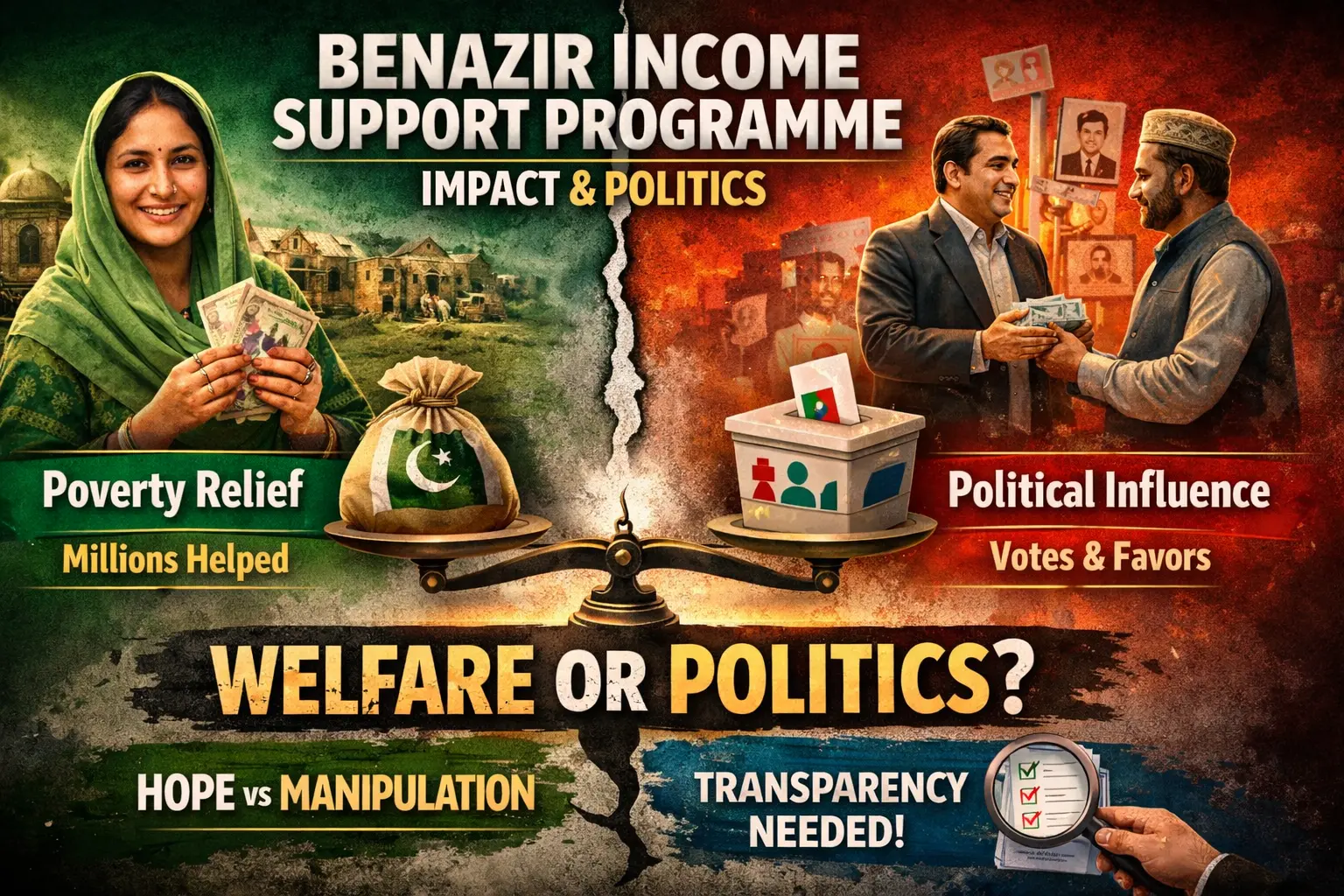
Benazir Income Support Programme: Impact, Politics & Transparency Issues
The Benazir Income Support Programme is one of the largest financial aid systems in Pakistan, created to support low-income households through direct cash assistance. Since its launch in 2008, it has become a critical support mechanism for millions of families, especially women who receive payments directly.
On the surface, it looks like a straightforward welfare program. But if you look deeper, it’s not that simple. The system has always carried political weight alongside its social purpose.
📌 How BISP Started
The program was introduced during a period of economic stress when inflation and basic living costs were rising rapidly. It was launched under the government of Pakistan Peoples Party and named after Benazir Bhutto, which immediately gave it political significance.
From day one, it wasn’t just about poverty relief — it also carried symbolic and political value.
Key elements included:
- Direct cash payments without strict conditions
- Targeting women as primary recipients
- Focus on immediate financial relief
These decisions helped vulnerable families, but they also opened the door for political influence.
⚠️ Early Problems: Political Control Over Beneficiaries
In the beginning, the selection process wasn’t data-driven. Instead, politicians played a major role in deciding who received support.
That created obvious issues:
- Beneficiaries were often selected based on political connections
- Supporters of ruling parties had better access
- Deserving families in opposition areas were sometimes ignored
This is where the concept of clientelism comes in — basically, using public resources to build political loyalty.
And let’s be honest: that’s exactly what was happening.
🔄 The Poverty Scorecard Reform
To fix this mess, the government introduced a system based on household data instead of political recommendations.
This method evaluated:
- Income levels
- Living conditions
- Assets
The goal was simple: remove political bias and make selection more objective.
This reform did improve things:
- Reduced direct interference from politicians
- Increased credibility of the program
- Built a structured national database
But it didn’t completely eliminate political influence.
🧠 The Reality: Politics Still Exists in the System
Even after reforms, the program hasn’t fully escaped political association.
Here’s how influence still shows up:
- The program’s identity is still tied to Benazir Bhutto
- Governments highlight it heavily during election campaigns
- Some regions receive more attention depending on political alignment
- Beneficiaries sometimes view payments as favors rather than rights
So while the system is more structured now, it’s not politically neutral.
🌍 Not Just a Pakistan Problem
If you think this is unique, you’re wrong.
Similar patterns exist globally:
- Brazil’s welfare programs increased political popularity of ruling parties
- Mexico’s cash schemes had electoral influence
- African countries like Kenya and Ghana saw uneven distribution
- India has faced similar accusations in subsidy programs
Bottom line:
When governments distribute money, politics almost always follows.
✅ Real Impact – What BISP Has Actually Achieved
Despite all the criticism, ignoring its benefits would be dishonest.
The program has delivered real results:
- Millions of families rely on it for survival
- Women now have more control over household finances
- Extreme poverty has decreased in multiple regions
- Some improvement in education and health outcomes
So yes — it works. But it’s not perfect.
🚧 Major Challenges That Still Exist
If the program wants long-term credibility, these issues need fixing:
1. Transparency Problems
People still question how beneficiaries are selected.
2. Outdated Data
Poverty conditions change, but data updates are not always frequent.
3. Regional Imbalance
Some areas still feel underrepresented.
4. Political Branding
The program is still linked to a specific political identity.
5. Institutional Independence
There’s no full guarantee that future governments won’t influence it again.
👥 Role of Public & Media
This isn’t just the government’s responsibility.
The public plays a role too:
- Communities can monitor local distribution
- Media can expose irregularities
- Citizens can demand transparency
- Awareness can reduce political dependency
Without pressure from society, systems like this drift back into misuse.
❓ Quick Answers
Is BISP completely free from politics?
No. It’s better than before, but not fully neutral.
Has it helped reduce poverty?
Yes, especially in rural and low-income communities.
Why is it called political sometimes?
Because of its history and ongoing association with political leadership.
Can it become fairer?
Yes — but only with transparency, updated data, and reduced political branding.
🏁 Final Verdict (No Sugarcoating)
BISP is both:
👉 A lifeline for millions
👉 And a tool that has been politically influenced
Both things are true at the same time.
If you think it’s purely welfare, you’re naive.
If you think it’s useless, you’re wrong.
The real issue isn’t whether it works — it does.
The real issue is whether it can ever become completely fair and independent.
Right now? Not fully.
📌 Conclusion
The Benazir Income Support Programme remains a cornerstone of social support in Pakistan. It has improved lives, empowered women, and reduced financial pressure for millions.
But its long-term success depends on one thing:
👉 Removing political influence completely.
Until that happens, it will always sit in a grey area — somewhere between genuine welfare and strategic politics.


