Apna Khait Apna Rozgar Scheme 2026 – 3 to 5 Acres Free Land for Poor Families in Punjab
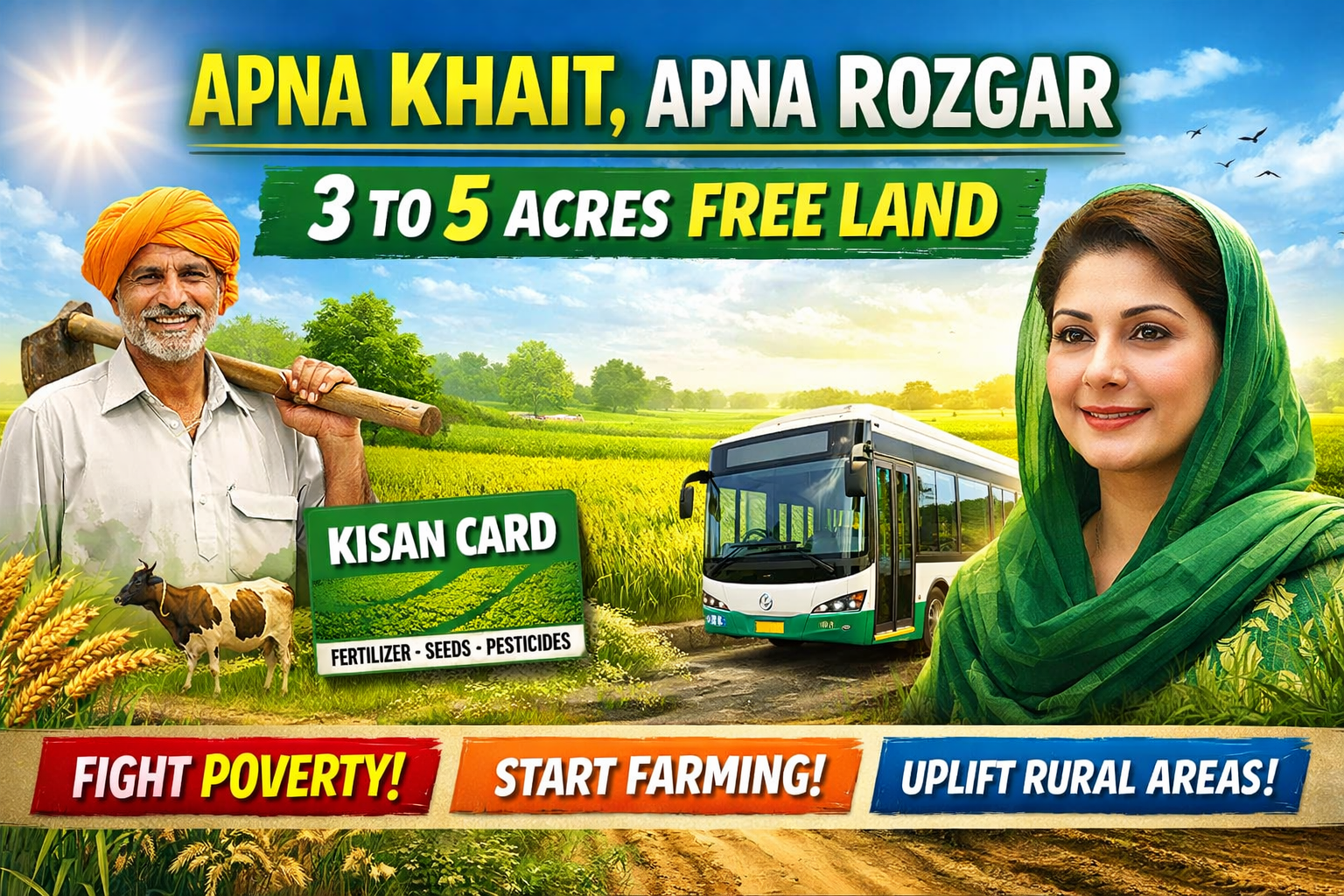
The Government of Punjab has launched a major welfare initiative called Apna Khait Apna Rozgar Scheme 2026. Under this program, poor and landless families will receive 3 to 5 acres of free state land to start farming and build a stable future.
This announcement was made by Punjab Chief Minister Maryam Nawaz during the inauguration ceremony of electric bus services in Rajanpur.
The scheme aims to reduce poverty, increase employment, and support sustainable development across Punjab. In this article, you will find complete details about eligibility, benefits, land distribution, Kisan Card, and other important announcements.
What is Apna Khait Apna Rozgar Scheme?
Apna Khait Apna Rozgar is a government program designed to provide free agricultural land to underprivileged and landless citizens of Punjab.
Key Highlights of the Scheme
- 250,000 acres of state land will be distributed
- Each eligible family will receive 3 to 5 acres
- Land will be given completely free of cost
- Focus on sustainable farming and income generation
- Special support through Kisan Card
The main goal is simple: give poor families land so they can earn their own livelihood instead of depending on aid.
Total Land Allocation Under the Scheme
The Punjab government has allocated 250,000 acres of state-owned land for this initiative.
This is not a small pilot project. It is a large-scale land distribution plan that can benefit thousands of families across Punjab.
How Much Land Will Each Family Get?
Eligible families will receive:
- Minimum: 3 acres
- Maximum: 5 acres
The exact size will depend on availability and family eligibility criteria.
This land can be used for:
- Crop farming
- Vegetable cultivation
- Livestock-related activities
- Other agriculture-based income sources
Who Can Apply for Apna Khait Apna Rozgar?
Although the detailed application process is expected to be announced officially, the scheme is mainly for:
- Landless families
- Poor and underprivileged citizens
- Individuals without stable income
- Residents of Punjab
If you already own agricultural land, you are unlikely to qualify. The purpose is to uplift those who have nothing.
Objective of the Scheme
The main objectives include:
1. Poverty Reduction
By giving land instead of cash, the government wants to create long-term income opportunities.
2. Sustainable Livelihood
Farming is a permanent income source. Once a family starts agriculture, they can earn season after season.
3. Inclusive Development
The scheme ensures that development is not limited to major cities like Lahore, but reaches remote and underdeveloped districts.
Kisan Card for Farmers – Additional Support
Along with land distribution, the government also announced the launch of a Kisan Card.
What is the Kisan Card?
The Kisan Card will allow farmers to:
- Purchase fertilizers
- Buy pesticides
- Get quality seeds
- Access farming-related support
This card will make agricultural inputs more affordable and accessible.
Let’s be clear — land alone is not enough. Farmers need tools, seeds, and fertilizers. The Kisan Card addresses that gap.
Expansion of Electric Bus Services in Rajanpur
During the same event, Chief Minister Maryam Nawaz also announced expansion of electric bus services to Rajanpur.
Important Announcements:
- Electric buses currently operating in Lahore will be introduced in Rajanpur
- 1,100 additional electric buses will be inducted into Punjab’s transport system
- Electric buses will operate on all major routes in Rajanpur
- Affordable and modern transport facilities will be provided
This shows that the government is not focusing only on agriculture but also on transportation and infrastructure development.
Balanced Development Across Punjab
Maryam Nawaz emphasized that no district would be ignored.
For years, districts like Rajanpur have faced underdevelopment. According to the government, that gap is now being addressed.
Focus Areas of Punjab Government
- Social welfare
- Infrastructure development
- Agricultural growth
- Transport modernization
- Equal opportunities for all districts
The message is clear: development should not stay limited to major cities.
Why This Scheme Matters
Let’s analyze the real impact.
Economic Impact
If 250,000 acres are distributed properly:
- Thousands of families can become self-employed
- Agricultural production can increase
- Rural poverty can reduce
Social Impact
- Families will gain financial independence
- Rural migration to cities may decrease
- Underdeveloped areas may grow economically
Long-Term Sustainability
Unlike short-term cash programs, land distribution creates:
- Permanent assets
- Ongoing income generation
- Multi-generational benefits
However, success depends on proper implementation, transparency, and monitoring.
Challenges the Government Must Handle
Let’s be realistic.
Large land distribution programs face common problems:
- Corruption in beneficiary selection
- Land disputes
- Lack of farming knowledge
- Poor irrigation support
If the government fails to manage these issues, the scheme will struggle.
Land without water, training, and market access is useless. The administration must ensure proper agricultural extension services.
Expected Application Process
Although the official method has not been fully announced yet, it will likely include:
- Application form submission
- Verification of income and land ownership status
- District-level screening
- Final approval by government authorities
Keep checking official Punjab government announcements for updates.
Do not rely on rumors or unofficial agents.
Is Apna Khait Apna Rozgar a Game-Changer?
On paper, yes.
If implemented honestly and efficiently, this can become one of Punjab’s largest poverty-reduction initiatives.
But here’s the truth: big announcements are easy. Execution is hard.
The real test will be:
- Transparent selection
- Fair distribution
- Continuous monitoring
- Farmer training programs
Without these, it will become just another headline.
Conclusion
The Apna Khait Apna Rozgar Scheme 2026 is a major step by the Punjab government to support poor and landless families. With 250,000 acres allocated and 3 to 5 acres provided per family, this initiative aims to promote sustainable livelihoods and inclusive development.
Alongside this, the launch of Kisan Card and expansion of electric buses in Rajanpur shows a broader development vision covering agriculture, infrastructure, and social welfare.
Now the focus must shift from announcements to action.
If properly executed, this scheme can transform rural Punjab. If not, it will remain a promise on paper.
Stay updated through official government sources for application details and eligibility announcements.